Trezor Login — Official Guide to Accessing Your Trezor Wallet Securely
The Trezor Login process is the secure method by which users access accounts managed by a Trezor hardware wallet. Unlike custodial platforms, Trezor places private keys on a dedicated device under the user's control. Logging in with a Trezor device therefore involves device presence, PIN entry, and transaction confirmation on the hardware itself. This guide explains the purpose of Trezor Login, step-by-step instructions for common login flows, security considerations, troubleshooting tips, and answers to frequently asked questions.
What is Trezor Login?
Trezor Login refers to the series of actions that authenticate a user and enable interaction between a computer or mobile application and a Trezor hardware device. Because private keys never leave the device, the "login" is effectively a local authentication and consent flow: the computer requests an operation, the device displays details, the user verifies and approves on the device, and the device cryptographically signs the requested operation. This model minimizes exposure to online threats while preserving user control.
Typical Trezor Login Flows
- Device connection and detection: Connect the Trezor device to the computer via USB (or via supported bridge solutions). The application (Trezor Suite or compatible wallet) detects the device and initiates a session.
- PIN entry: Enter the device PIN directly on the Trezor (or, for Model T, on the touchscreen). The PIN unlocks the device for the session without exposing the PIN to the host computer.
- Optional passphrase: If the user has enabled a passphrase, it is entered on the device or via a supported input method. The passphrase derives a separate wallet and provides an additional security layer.
- Account selection: Select the account or address to use within the application; the application will query the device for public keys or addresses as needed.
- Transaction or operation confirmation: When the user initiates a transaction or signs data, the Trezor displays details on-device; the user must physically approve to complete the signature.
Security Considerations for Trezor Login
Trezor's security model is based on isolating private keys inside secure hardware and requiring physical confirmation for sensitive actions. Key best practices for secure Trezor Login include:
- Keep your recovery seed offline: Record the seed on paper or a certified metal backup. Never store the seed digitally or share it with anyone.
- Use a strong PIN and enable passphrase if appropriate: A strong PIN protects the device if lost; a passphrase creates an additional hidden wallet for advanced protection.
- Verify device screens: Always verify wallet addresses and transaction details on the Trezor display before approving.
- Download software from official sources: Use Trezor Suite or verified third-party integrations and confirm HTTPS URLs match the official domain.
- Be cautious with browser extensions: Prefer using Trezor Bridge or Trezor Suite rather than untrusted browser plugins; disable unnecessary extensions that may interfere with device communication.
Using Trezor Suite to Perform a Secure Login
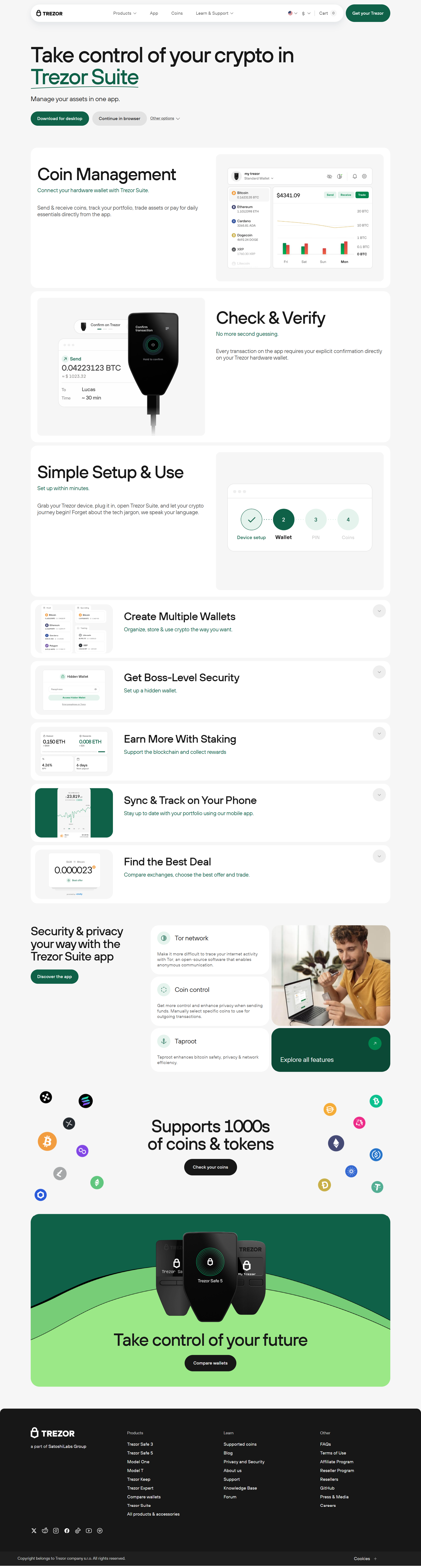
Trezor Suite provides a recommended, secure environment to interact with your device. Typical Trezor Login via Suite involves connecting the device, authenticating with PIN (and passphrase if used), and selecting or adding accounts. All transaction construction occurs in Suite, while signature approval occurs on the device. Suite also performs firmware checks and warns if the device firmware is out of date or unverified.
Mobile and Web Login Notes
Mobile access and web integrations are supported through official channels and bridge software. On mobile, USB-OTG or supported Bluetooth workflows may be available depending on the device model. For web wallets, use Trezor Bridge or the official Suite web interface to avoid relying on third-party browser extensions. Regardless of platform, always confirm transaction details on the Trezor hardware screen.
Troubleshooting Common Trezor Login Problems
If you encounter login issues, the following checklist addresses common causes and resolutions:
- Device not detected: Verify USB cable and port; try another cable or port. Ensure Trezor Bridge or required drivers are installed and that your operating system is supported.
- PIN entry not accepted: Confirm you are entering the correct PIN; if you repeatedly enter the wrong PIN, the device may increase retry limits or wipe after set attempts depending on configuration.
- Passphrase confusion: If a passphrase is in use and you cannot access a wallet, check whether the passphrase is being entered correctly and that you are using the intended input method (on-device vs host input).
- Software compatibility: Ensure Trezor Suite or the chosen wallet is up to date and downloaded from the official source.
- Firmware alerts: If the device requests a firmware update, follow official instructions; do not use unverified firmware builds.
Advanced Login Scenarios
Advanced users may utilize passphrases for hidden wallets, export public keys for read-only monitoring, or integrate Trezor with third-party services for specialized workflows. When using public key exports, treat exported data as read-only and avoid providing access to private or seed material. If you enable automation or API access via third-party services, ensure those services follow strong security practices and never require seed or private key input.
Frequently Asked Questions (FAQ)
Q1: Do I log in with a username and password like a web service?
A: No. Trezor Login uses device-based authentication. Access is granted through physical device presence, PIN entry on the device, and optional passphrase validation. There is no central Trezor username/password that controls your wallet.
Q2: What happens if I forget my PIN?
A: If you forget your PIN, the device may be reset depending on retry limits. You can recover your wallets on a new device using your recovery seed. This is why maintaining secure offline copies of your seed is essential.
Q3: Is it safe to enter my passphrase on the computer?
A: Best practice is to enter passphrases directly on the Trezor device when supported. If a host input is required, ensure you are using official software and a secure environment.
Q4: Can someone log in remotely to my Trezor wallet?
A: No. Remote login is not possible without the physical device and the PIN/passphrase. This physical requirement greatly reduces remote compromise risks.
Q5: Do I need Trezor Suite to log in?
A: Trezor Suite is the recommended official application for secure interaction. Some third-party wallets support Trezor devices, but they should be used with caution and only if they are reputable and compatible with Trezor’s security model.
Q6: How do I verify I'm using the official software?
A: Download from the official Trezor domains, confirm HTTPS, and verify checksums or signatures where provided. Avoid installing software from untrusted sources or links received via unsolicited emails.
Conclusion
Trezor Login emphasizes physical control, transparent verification, and minimal reliance on remote credentials. By authenticating through the device, using a strong PIN and optional passphrase, and always confirming details on the device screen, users achieve a high level of protection for their digital assets. For best results, use official Trezor Suite or verified integrations, keep software current, and safeguard your recovery seed offline.
Disclaimer: This information is provided for educational purposes only. Always use official Trezor resources when downloading software or performing device operations. Never share your recovery seed, PIN, passphrase, or private keys with anyone. For device-specific support consult the official Trezor Help Center.